REFLEX GAME GUIDE / OCTOBER 10, 2026
Two-player reaction games on one iPhone: how to pick a fair reflex duel
Pick a one-phone reaction game with equal controls, one shared go signal, a clear false-start rule, short rounds, and an immediate rematch. Then swap physical sides before deciding who is faster.
By the DuoDragonz Editorial Team · Published October 10, 2026
The short answer: fairness starts before the signal
A good two-player reaction game gives both people the same task at the same moment. The strongest one-phone setup uses equal target size, equal reach, a random delay before the go cue, and an explicit penalty for moving early. One round can be luck. A short series with a side swap tests whether the result survives a different seat and viewing angle.
The examples below come from current U.S. App Store descriptions, not DuoDragonz hands-on testing or a ranked review. Modes, prices, purchases, accessibility support, and availability can change, so check the live listing before playing.
Four reaction formats compared
| Format | What it tests | Fairness check |
|---|---|---|
| Release on the signal | A clean response to one random go cue | Both players need the same hold area, cue, and early-release penalty |
| Tap the matching cue | Reaction plus color, word, math, or attention | Reading or recognition can matter as much as raw reflex speed |
| Split-screen target race | Repeated visual scanning and quick taps | Target size, travel distance, and screen orientation should match |
| Button-mash or control duel | Rhythm, endurance, or movement under pressure | This is a speed contest, not a pure reaction-time measurement |
Five current listings that document one-phone reaction play
| Game | Documented player mode | Useful when |
|---|---|---|
| Pretzel: 2 Player Reflex Game | Two people share the same screen | Reflex, attention, and memory rounds in one offline game |
| Thumbslap: 2 Player Duel | Both players use one phone | Color, word, math, and Stroop-style reaction choices |
| Reflex Arena: Split Screen PvP | Local split-screen play on the same device | A direct same-screen reflex contest |
| Tap Duel: Reaction Time Test | Local one-device duel, plus other challenge modes | A hold-and-release format with an explicit early-action loss |
| 2 Player Games: Duel Party | Two players compete simultaneously on one screen | Reflex, tapping, math, memory, and control games in one set |
Pretzel documents two people sharing the same screen for reflex, attention, and memory play. Thumbslap describes a one-phone reaction duel with several cue types. Reflex Arena documents local split-screen competition on one device. Tap Duel lists one-device 1v1 play and an early-action loss. Duel Party describes simultaneous one-screen games, including reflex and tap races.
Run the 90-second reflex fairness check
- Match the starting posture. Both players should place the same finger in the same type of ready area.
- Trigger one false start. Confirm the game cancels, penalizes, or clearly identifies an early input.
- Check the cue from both seats. Color, text, sound, and motion should be equally readable from either side.
- Play three rounds, then swap sides. Repeat the same mode from the opposite physical position.
- Use a series result. Decide the winner with a short best-of-five or best-of-seven rather than one tap.
This is an editorial comparison method, not a laboratory latency test. It cannot isolate touch-sampling delay, animation timing, display differences, or player practice effects. It does expose obvious layout and rule advantages before they spoil a rematch.
Five questions every reflex duel should answer
- Where must each finger rest before the round starts?
- Is the go signal random and visible to both people at once?
- What happens when somebody taps or releases too early?
- Does the game announce one authoritative winner or a clear tie?
- Can both players start the next round without leaving the match?
A millisecond number is only meaningful inside the same mode and session. A hold-and-release duel, a visual-search grid, and a math cue are different tasks even when each produces a fast-looking score.
How this differs from a general competitive game
Reaction games are a narrow category of competitive play. Their main question is whether both people receive the same signal and equivalent input opportunity. Strategy, sports, and control games add positioning, resource choices, or continuous movement. Our broader competitive iPhone games fairness guide covers those longer matches, results, side advantages, and rematch formats. For air hockey, ping pong, soccer, pool, racing, and penalty-kick choices, use our one-phone sports games guide.
What changes with iPhone Duo?
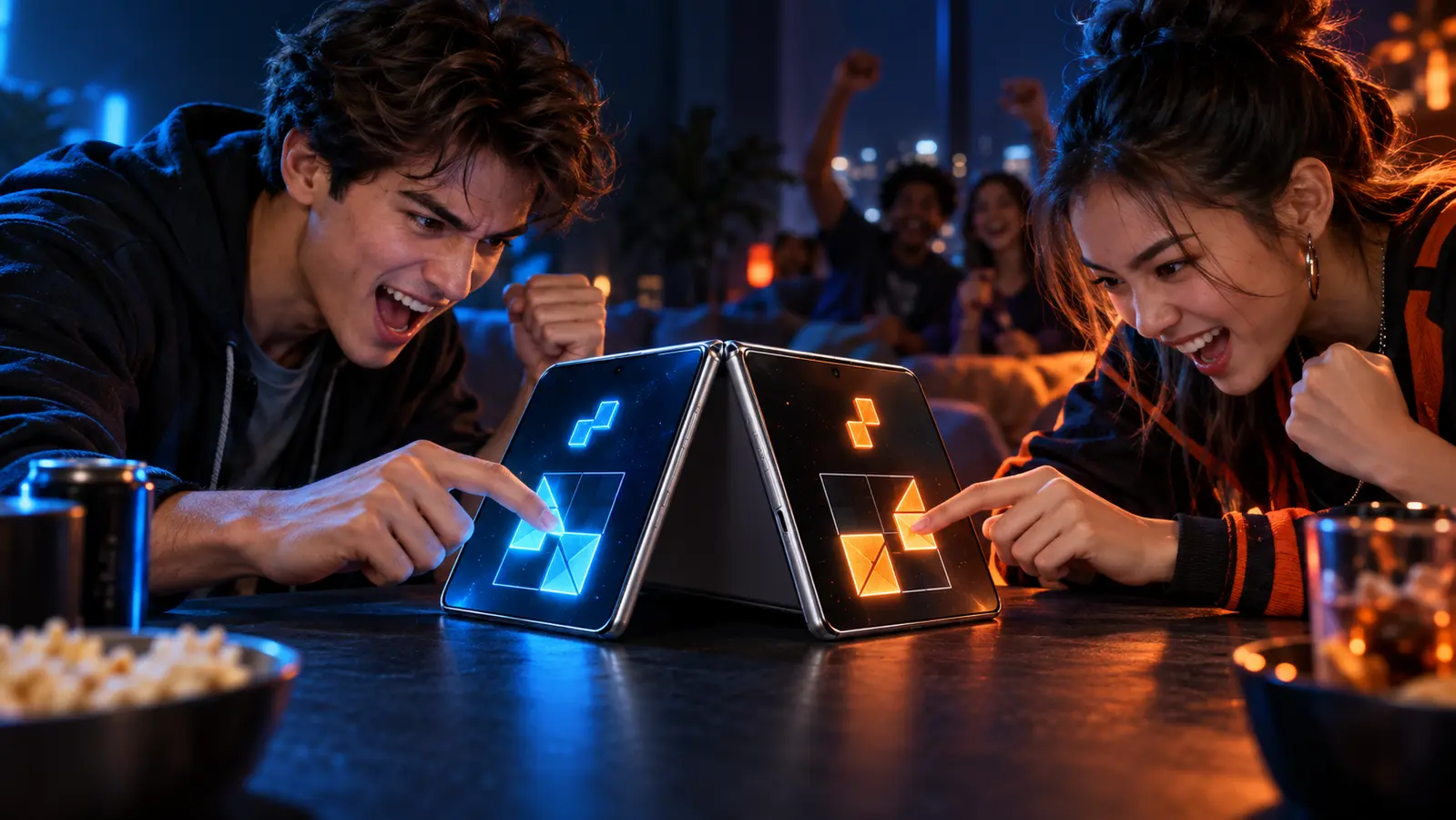
Apple describes iPhone Duo as a foldable iPhone with a dual-display system and its largest iPhone display when open. More display area may help separate controls, but screen size alone does not prove that an existing game supports a special tabletop pose, fold-aware target placement, opposite-display input, or equal viewing angles. See Apple's current iPhone Duo page for confirmed device information.
The App Store listings cited here document ordinary iPhone or iPad modes. Look for a current developer statement or release note that names iPhone Duo before treating a game as optimized for it. Our best iPhone Duo games guide keeps device compatibility evidence separate from fold-native design.
Where DuoDragonz fits
DuoDragonz is developing Game 001, currently using the working title Puzzle Rush, as a simultaneous face-to-face puzzle race. It is not available in the App Store, and this article does not claim a public build, measured input latency, or tested iPhone Duo layout.
Browse the current DuoDragonz game projects or join early access for verified development milestones, future playtest opportunities, and the eventual official download link.
Frequently asked questions
Can two people play a reaction game on one iPhone?
Yes. Current App Store listings document same-screen, split-screen, and one-device local duels. Check the exact mode because some reaction games instead require a phone for each player or an online room.
What makes a one-phone reaction duel fair?
Both players should receive the same cue, target size, input method, starting posture, and penalty for moving early. A short series with a physical side swap is more informative than one isolated round.
Does a lower millisecond score always mean the better player?
Not across different apps or input methods. A tap, hold-and-release action, visual search, and math cue measure different tasks. Compare players inside the same mode, device, and session.
Are these reaction games optimized for iPhone Duo?
The cited listings document ordinary iPhone or iPad play. They do not by themselves prove fold-aware controls, hinge behavior, opposite-display play, or specific iPhone Duo optimization.