NAVAL STRATEGY GUIDE / OCTOBER 3, 2026
Two-player Battleship games on iPhone: what to check before you play
One shared phone, an online duel or a match in Messages? Choose the right setup before you take the first shot.
By the DuoDragonz Editorial Team · Published October 3, 2026 · Listing-based guide
The quick choice: investigate BYRIL’s Sea Battle Online for its listed one-device mode, GamePigeon for iMessage, or Marmalade’s BATTLESHIP for the licensed adaptation and online competition.
These are different setups. A two-player label does not guarantee that both people can share one iPhone.
A good naval guessing game makes every shot a decision: search a fresh patch of ocean, follow up a hit, or spend a limited ability to learn more. On iPhone, choosing the right game starts with something simpler: how will the two of you play?
If you each have a device, online or iMessage play can keep your fleets private. Sharing one phone requires a proper handover system. Here is how to choose a setup and avoid discovering the wrong multiplayer mode after downloading.
Availability note: We checked the U.S. App Store and publisher pages on October 3, 2026. The options below are based on those listings, rather than hands-on testing. Availability, purchases and features can change.
Start with the multiplayer format
“Two-player” describes the number of people, not the equipment required.
- One device: You take turns holding the same phone. The game needs to hide private information before every handover.
- Two devices nearby: You each have a private display. Check whether the game requires internet access or supports a local connection.
- Online with a friend: Look for a direct invitation or private match option. Random matchmaking alone may not get you into the same game.
- Inside Messages: An iMessage game belongs to a conversation. Check that both people can access the required app and service.
Three options to investigate
Hidden information matters more than screen size
A ship-placement game depends on one player knowing something the other does not. A larger display can make a grid easier to tap, but it cannot protect a fleet that is visible to both people.
For shared-phone play, check three moments: placing ships, switching players, and returning after an interruption. A useful handover screen should conceal the previous player’s board until the next player deliberately continues.
Keep the phone facing its current player, and agree to look away during placement. Avoid mirroring the display to a television. If you prefer to sit side by side and watch every move, separate devices may suit this genre better.
Agree on the rules before the first shot
Two games can use similar grids while rewarding different decisions. Before a serious match, check:
- Can ships touch, including diagonally?
- Does a hit grant another shot?
- Do sunk ships reveal their full shape?
- Are weapons, sonar, or other abilities limited?
- Can both players start with the same equipment?
- What happens if somebody leaves or loses connection?
These details change strategy. A rule that forbids touching ships can let you rule out squares near a confirmed wreck. Without that rule, those squares remain possible targets. Likewise, a multi-square attack changes the value of scattering your fleet.
For a straightforward contest, begin with matching settings and the simplest shared ruleset. Add special abilities once both players understand their costs and effects.
A practical search strategy
Separate searching from finishing. While you have no active hit to pursue, spread shots across plausible ship locations. After a hit, test nearby squares that could extend the ship; once you identify its direction, follow that line.
A checkerboard search has a specific mathematical use: if every remaining ship is straight, occupies at least two squares, and runs horizontally or vertically, it must cross both checkerboard colours. Searching one colour can therefore find every such ship. That reasoning stops working for a remaining single-square ship.
Treat the board as evidence. Exclude placements contradicted by misses and confirmed sunk ships, rather than repeatedly guessing wherever a ship “feels” likely.
Where Fleet Fighters fits
Fleet Fighters is our in-development naval-strategy project at DuoDragonz. A private browser playtest exists, exploring ship placement, weapons, and information-gathering decisions. There is no public App Store release, and iPhone Duo compatibility has not been verified.
Read about the concept on our Fleet Fighters page. For broader choices, visit our two-player iPhone games guide. It keeps general game discovery separate from fold-aware hardware claims.
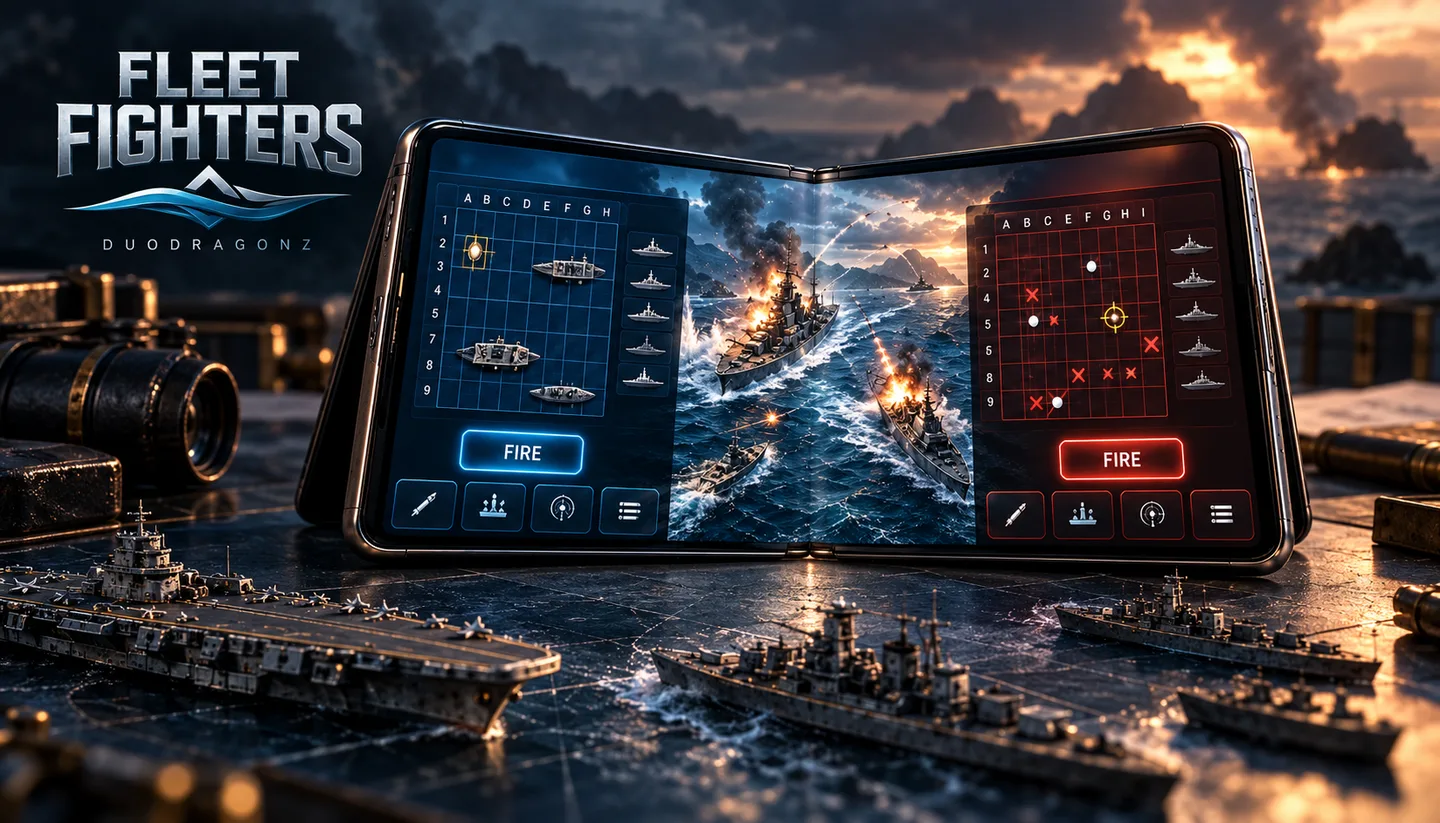
Fleet Fighters is a separate DuoDragonz project. It is not affiliated with Hasbro or the official BATTLESHIP app. The hero image illustrates our concept, not the graphics of the games listed above.
Frequently asked questions
Can two people play a Battleship-style game on one iPhone?
Yes, some apps explicitly advertise this. BYRIL’s Sea Battle Online is one listed example. Check its handover behaviour before committing to a match.
Is GamePigeon Sea Battle the official Hasbro BATTLESHIP app?
They are separate products. Sea Battle appears within GamePigeon’s iMessage collection; Marmalade publishes the licensed BATTLESHIP adaptation.
Does offline mean two-player pass-and-play?
Do not infer that from the word alone. Offline support may refer to playing against the computer. Look for an explicit same-device multiplayer description.
What should I try first?
For a shared phone, investigate the explicitly listed one-device option. For Messages-based play, look at GamePigeon. For the licensed adaptation and online competition, look at Marmalade’s BATTLESHIP. Your preferred setup is the most useful starting point.
For related setup checks, see same-device versus online multiplayer and our offline game checklist.